
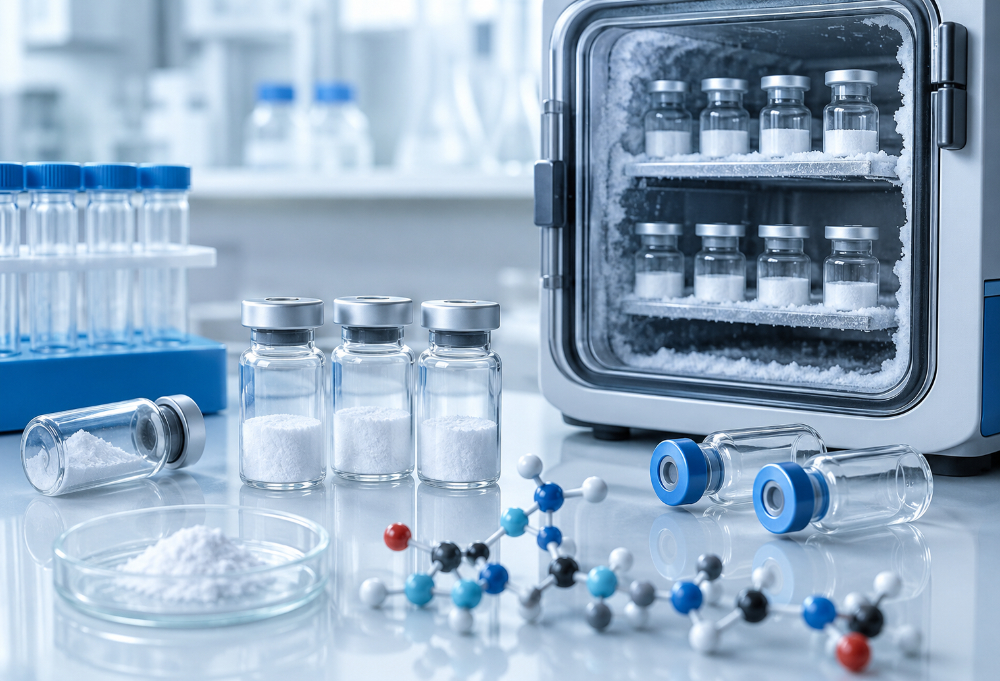
Peptide research has advanced significantly over the past two decades, and with that progress comes a greater responsibility to understand how these delicate compounds behave outside of the body. Whether you are working with BPC-157 and TB-500 research peptides or exploring newer sequences, maintaining compound integrity from the moment of synthesis to the point of reconstitution is one of the most critical factors in producing reliable, reproducible results.
For researchers sourcing materials from a research peptide supplier in the Midwest, understanding the science behind peptide preservation is not optional; it is foundational.
What Is Lyophilization and Why Does It Matter?
Lyophilization, commonly referred to as freeze-drying, is the process of removing water from a peptide sample while preserving its structural integrity. The process works in three stages: freezing the solution, applying a vacuum to trigger primary drying through sublimation, and then completing secondary drying to remove any residual moisture bound to the compound.
The reason lyophilization has become the industry standard for peptide preservation is straightforward. Peptides in aqueous solution are highly vulnerable to hydrolysis, oxidation, and microbial contamination. When water is removed, these degradation pathways are dramatically slowed, and the compound can be stored for extended periods without significant loss of potency or purity.
For researchers working with lyophilized peptide storage protocols, this process offers a meaningful advantage over liquid storage. A properly lyophilized peptide, stored under appropriate conditions, can maintain stability for months or even years. By contrast, a reconstituted peptide stored improperly might degrade within days.
The physical appearance of a lyophilized peptide is typically a white or off-white powder or cake. This form is fragile in some ways; exposure to humidity, heat, or light can begin to compromise the compound even before reconstitution. Packaging materials, vial integrity, and storage environment all play a role in how well the lyophilized form holds up over time.
Optimal Storage Conditions for Lyophilized Peptides
Once a peptide has been lyophilized, storage conditions become the primary variable determining how long the compound will remain viable. Temperature is the most significant factor. Most lyophilized peptides should be stored at -20 degrees Celsius for long-term preservation. Some particularly sensitive sequences may require storage at -80 degrees Celsius, while others can tolerate short-term storage at 4 degrees Celsius if reconstitution is planned within a few weeks.
Light exposure is another underappreciated concern. UV radiation can break peptide bonds and trigger oxidative reactions even in dry compounds. Amber vials or opaque containers are standard practice in most research settings, and storing vials in a drawer or box inside the freezer adds an additional layer of protection.
Humidity is arguably the most immediate threat to lyophilized peptide storage integrity. Even brief exposure to ambient moisture can cause the powder to begin absorbing water, restarting the hydrolysis clock. For this reason, researchers are advised to allow cold vials to equilibrate to room temperature before opening them. This simple step prevents condensation from forming on the interior surfaces of the vial when cold glass meets warm, humid lab air.
For labs located in regions with significant seasonal humidity variation, such as those near Underwood, MN, these precautions take on additional importance. The upper Midwest experiences considerable humidity swings between summer and winter, and labs without climate-controlled storage areas may see faster degradation in peptide samples left unprotected.
Desiccants are also commonly used alongside proper temperature storage. Silica gel packets placed in the storage container absorb ambient moisture and help maintain a dry microenvironment around the vials. This is especially useful for samples that are accessed repeatedly over time.
BPC-157 and TB-500: Research Considerations and Stability Profiles
Among the most widely studied peptides in current research settings are BPC-157 and TB-500. BPC-157 and TB-500 research has grown considerably in recent years, driven by interest in their respective mechanisms and the volume of preclinical literature examining their behavior in various biological models.
BPC-157, a pentadecapeptide derived from a body protection compound found in gastric juice, has been studied extensively in animal models for its effects on tissue repair, angiogenesis, and gastrointestinal function. Its relatively short sequence makes it somewhat more stable than larger peptides, but it is still susceptible to degradation through oxidation and improper storage. Lyophilized BPC-157 should be kept at -20 degrees Celsius and protected from light. Once reconstituted, it should be used within a defined window, typically within a few weeks if stored at 4 degrees Celsius, or within a shorter period at room temperature.
TB-500, which is a synthetic version of the naturally occurring Thymosin Beta-4 peptide, presents slightly different stability considerations. Its longer amino acid chain and structural complexity mean it may be more sensitive to freeze-thaw cycles. Researchers working with TB-500 are generally advised to aliquot the compound into single-use portions before long-term storage, minimizing the number of times any individual sample is exposed to temperature cycling.
Both peptides illustrate a broader principle in peptide research: the specific stability profile of a compound is tied to its sequence, molecular weight, and the presence of particularly reactive amino acid residues such as methionine, cysteine, or tryptophan. Researchers sourcing these compounds from a research peptide supplier in the Midwest should expect to receive detailed certificates of analysis and stability data that reflect these considerations.
Peptide Reconstitution Guidelines for Accurate Research
Reconstitution is the process of dissolving a lyophilized peptide into an appropriate solvent to prepare it for use in research. Peptide reconstitution guidelines vary somewhat depending on the specific compound, but a number of core principles apply across most research applications.
The choice of solvent matters considerably. For most peptides, sterile water or bacteriostatic water is appropriate. Bacteriostatic water, which contains a small concentration of benzyl alcohol as a preservative, is preferred when the reconstituted solution will be stored for more than a day or two. Acetic acid solutions (typically 0.1 percent) are sometimes used for peptides that are not readily soluble in water alone, particularly those with a high proportion of hydrophobic residues.
The reconstitution volume determines the final concentration of the solution. Researchers should calculate the desired concentration in advance and add solvent incrementally, avoiding vigorous shaking which can denature the peptide. Instead, the vial should be gently swirled or rolled between the palms until the powder is fully dissolved.
Temperature during reconstitution also matters. Reconstituting directly from a frozen state is inadvisable; vials should be allowed to reach room temperature before solvent is added. Adding cold solvent to a cold peptide can introduce dissolution issues that compromise the accuracy of the resulting solution.
Once reconstituted, the peptide solution should be aliquoted if not intended for immediate use. Repeated freeze-thaw cycles degrade both potency and purity. Single-use aliquots stored at -20 degrees Celsius represent the best practice for preserving sample integrity over time.
Conclusion
Peptide stability is a multifaceted challenge that requires attention at every stage of the research process. From the lyophilization process itself to the specifics of lyophilized peptide storage, reconstitution, and handling, each step introduces variables that can influence the quality of downstream results. Researchers engaged in BPC-157 and TB-500 research, or working with any complex peptide compound, benefit enormously from establishing rigorous protocols and sourcing materials from a reliable research peptide supplier in the Midwest. For labs in areas like Underwood, MN, where environmental factors add additional complexity, adherence to established peptide reconstitution guidelines is not just good practice; it is essential to the integrity of the science itself.
Need High-Purity Research Peptides in Underwood, MN?
At Elohim Peptides, we take pride in supporting laboratories and scientific investigators with consistently high-purity, rigorously tested research compounds you can trust for your in-vitro work. From lyophilized peptides like BPC-157, TB-500, and GHK-Cu to advanced options such as Tirzepatide analogs and Retatrutide, every product we offer is backed by third-party testing at ?99% purity and accompanied by batch-specific certificates of analysis to meet strict scientific standards. As a USA-based supplier headquartered in Underwood, Minnesota, we are committed to reliability, transparency, and excellence in every order we fulfill. If you are looking for a dependable partner for your research needs, we invite you to reach out to our team today and discover how Elohim Peptides can support your work.