
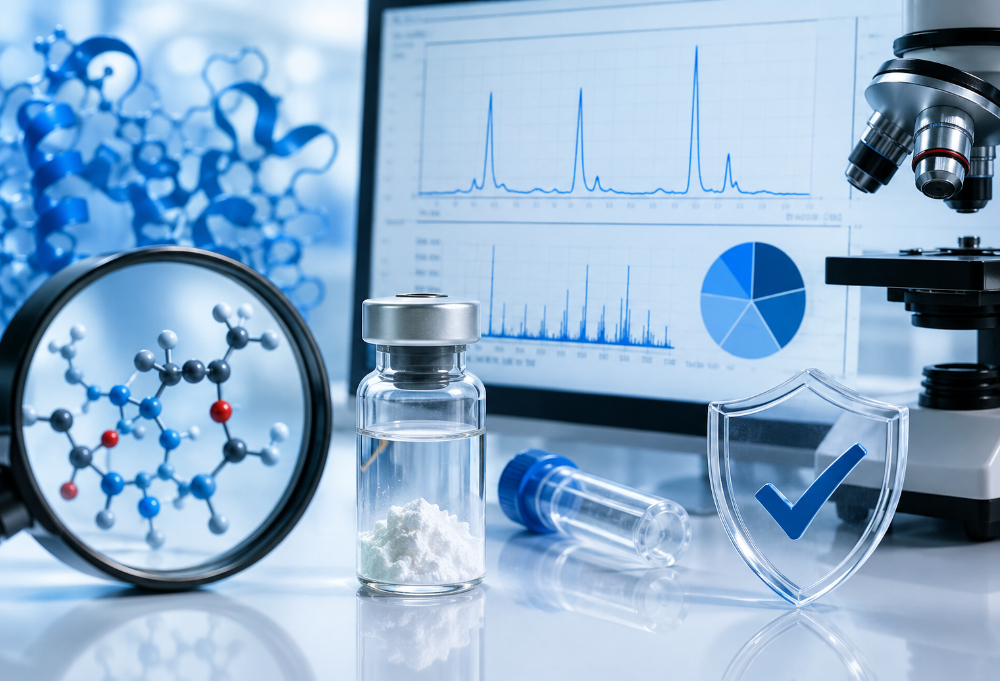
For laboratories and researchers in Underwood, Minnesota, peptide quality can directly affect the reliability of experimental work. A purity percentage printed on a product page is only useful when researchers can understand how that figure was established and whether independent analytical testing supports it.
Third-party testing and 99%+ purity are important considerations when evaluating research peptides because they provide researchers with additional information about identity, composition, and potential impurities. High purity does not automatically establish that a peptide is suitable for every experiment, but transparent analytical documentation can help researchers make more informed purchasing and experimental decisions.
What Local Researchers Should Know
- A 99%+ purity specification generally means the analytical method found the target peptide to account for at least 99% of the measured material under the conditions of that test.
- Independent third-party testing provides verification from a laboratory separate from the peptide supplier.
- Researchers should review the analytical method and available documentation rather than relying only on a purity percentage.
- Research organizations in Underwood and elsewhere in Otter Tail County should consider identity, purity, storage, handling, and lot-specific documentation together.
- Research peptides should remain within their stated research purpose and should not be treated as approved products for human use.
Why Are Third-Party Testing and High Purity Important for Research Peptides?
Third-party testing and high purity are important because researchers need reliable information about what a peptide sample contains before incorporating it into controlled laboratory work. Independent analytical results can add another layer of verification beyond a supplier’s internal quality-control process.
For researchers in Underwood, this matters for the same reason careful measurement matters throughout an experiment: uncertainty introduced at the material level can complicate interpretation later.
Elohim Peptides serves the research peptide market from Underwood, Minnesota. We believe researchers should be able to evaluate analytical information when selecting materials for legitimate laboratory research.
High purity should not be confused with proof of safety, effectiveness, or suitability for human use. Research-use materials have a different purpose, and the U.S. Food and Drug Administration has taken enforcement action when products labeled for research use were marketed in ways that established an intended human drug use.
What Does 99%+ Peptide Purity Actually Mean?
A 99%+ peptide purity result means an analytical test has measured a high proportion of the target peptide relative to detectable related material under the specific conditions and limitations of that method. It should not be interpreted as a universal statement that every quality characteristic of the sample has been verified.
Peptide synthesis can produce peptide-related impurities through incomplete reactions, truncations, or side reactions. FDA technical materials note that these impurities can be structurally similar to the intended peptide and may require sophisticated analytical methods to identify and quantify.
That distinction matters for researchers in Underwood and surrounding Otter Tail County communities. Instead of asking only, “Does this product say 99% pure?” researchers can ask what analytical procedure produced the result and whether additional testing supports the peptide’s identity.
How Does Third-Party Testing Add Confidence?
Third-party testing adds confidence by having an independent laboratory analyze a sample rather than relying exclusively on the seller’s internal assessment. Independence does not make a test infallible, but it can provide an additional quality-control checkpoint for researchers reviewing a peptide.
For laboratories around Underwood, Battle Lake, Dalton, Fergus Falls, and the surrounding west-central Minnesota region, documentation can be especially useful when repeatability and material traceability are priorities.
Researchers should look beyond the words “third-party tested.” Useful questions include which tests were performed, whether results correspond to the relevant batch or lot, when testing occurred, and what the reported measurements actually establish.
What Analytical Methods Can Be Used to Evaluate Peptides?
Chromatographic and mass-spectrometry-based methods can help characterize peptide materials, with different methods answering different analytical questions. FDA research has used techniques including HPLC-MS/MS, UHPLC-MS/MS, and high-resolution mass spectrometry to investigate peptide identity and impurity profiles.
High-performance liquid chromatography, commonly called HPLC, can separate components of a sample and provide information used to assess purity. Mass spectrometry can provide information related to molecular mass and can contribute to peptide identification and impurity characterization.
FDA research has also demonstrated why analytical depth matters. Its work on peptide products has used advanced liquid chromatography and mass spectrometry approaches to identify and characterize low-level peptide impurities.
For an Underwood research customer, the practical takeaway is straightforward: the testing method matters just as much as a percentage printed beside a product name.
What Should Researchers Look for in a Certificate of Analysis?
A useful Certificate of Analysis should give researchers enough information to connect analytical results with the material they are evaluating. Depending on the testing program, that may include identifying information, a batch or lot reference, analytical methods, reported purity, and supporting test results.
Researchers should check whether:
- The document can be connected to the relevant peptide and lot.
- The purity result identifies the analytical method used.
- Identity testing is provided when applicable.
- Testing dates and laboratory information are clear.
- The documentation is internally consistent.
- The reported results actually support the claims being made.
A COA should be read as analytical documentation, not simply as a marketing badge.
What Can Cause Quality Problems in Research Peptides?
Quality problems can originate from synthesis, purification, handling, storage, or inadequate characterization, which is why researchers should evaluate more than a single purity claim. Synthetic peptide production can generate related substances that are chemically similar to the intended sequence.
Common considerations include incomplete synthesis reactions, truncated sequences, side-reaction products, residual process-related material, degradation, and storage-related changes.
Minnesota’s seasonal temperature swings also make careful shipping and storage procedures worth considering. Researchers receiving materials in Underwood during a cold January week face different transportation conditions than those receiving a package during summer heat. Researchers should follow the storage conditions specified for the particular material rather than assuming one storage protocol applies to every peptide.
What Are Warning Signs of Weak Peptide Quality Documentation?
Weak peptide quality documentation often lacks enough specific information for a researcher to understand how identity or purity claims were established. A high percentage by itself should not replace supporting analytical information.
Potential warning signs include:
- A purity claim without an identified analytical method.
- Generic testing statements with no supporting documentation.
- A COA that cannot be associated with the relevant material or lot.
- Missing or unclear identity information.
- Conflicting information between product documentation and analytical results.
- Testing records that do not explain what was actually measured.
- Marketing language that treats research-use material as though it were intended for human administration.
These warning signs do not independently prove that a material is unsuitable. They indicate areas where a researcher may need additional information before proceeding.
How Should Underwood Researchers Compare Peptide Suppliers?
Underwood researchers can compare peptide suppliers by evaluating documentation transparency, analytical testing, purity information, identity verification, lot traceability, storage guidance, and research-use policies together. Price alone provides little information about whether a material is appropriately characterized for a particular research project.
One useful comparison is internal testing versus independent testing. Internal quality control can play an important role in a supplier’s process, while third-party analysis provides an additional independent data point. These approaches do not have to be mutually exclusive.
Researchers can also compare whether suppliers make analytical information accessible and clearly distinguish research materials from products intended for human or veterinary use.
What Mistakes Should Researchers Avoid When Evaluating Purity?
The most common mistake is treating “99%+” as a complete description of peptide quality, because purity is only one analytical characteristic. A better approach is to evaluate purity alongside identity, testing methods, documentation, lot information, handling requirements, and the needs of the specific experiment.
Another mistake is assuming every third-party test provides the same information. Different analytical methods have different capabilities, and results should be interpreted in the context of the method used.
Researchers should also avoid assuming that high analytical purity establishes safety for human use. It does not. FDA has repeatedly stated through enforcement actions that labeling a product “research use only” does not override evidence showing that the product is actually being marketed as a drug for human use.
A Common Underwood Research Scenario
A common local scenario involves a researcher comparing two peptide sources that advertise similar concentrations and purity levels but provide different levels of analytical documentation. One supplier may display a percentage with little context, while another may provide supporting analytical results tied to the material.
The better research process is not to select a product solely because its advertised number is higher. Instead, the researcher can examine how the result was obtained, whether independent testing was involved, and whether identity and lot information are available.
This type of documentation-focused comparison helps researchers in Underwood make decisions based on evidence rather than marketing language.
How Can Better Peptide Documentation Support Research Quality?
Better peptide documentation supports research quality by helping researchers understand and control one of the variables entering an experiment. Reliable analytical information cannot guarantee a particular experimental outcome, but it can reduce uncertainty about the material being studied.
Our role is to provide research peptide options with clear research-use positioning and relevant product information. Researchers should always determine whether a particular material and its documentation meet the requirements of their own protocol, institution, and analytical objectives.
What Is the Cost of Ignoring Peptide Quality?
Ignoring peptide quality can cost researchers time, materials, and confidence in experimental results because poorly characterized starting materials introduce another source of uncertainty. If an unexpected result occurs, inadequate material documentation can make troubleshooting more difficult.
For small laboratories and independent research operations around Underwood and Otter Tail County, repeating work can consume limited resources. Careful material selection at the beginning of a project can make subsequent experimental interpretation more straightforward.
Frequently Asked Questions
Why does 99%+ purity matter for research peptides in Underwood, MN?
A 99%+ purity result indicates that an analytical method measured a high proportion of the target peptide relative to detected related components. For Underwood researchers, it can be a useful quality indicator, but the analytical method, identity information, lot documentation, and experimental requirements should also be considered.
Does 99% purity mean a research peptide is safe for human use?
No. A 99% analytical purity result does not establish that a research peptide is safe, effective, sterile, or approved for human use. Purity is an analytical characteristic. Research-use peptides should be evaluated and handled according to their stated research purpose rather than interpreted as approved therapeutic products.
Why should researchers in Otter Tail County look for third-party testing?
Third-party testing can provide Otter Tail County researchers with an analytical assessment performed independently of the supplier. It offers an additional source of information when reviewing purity or identity claims. Researchers should still examine what method was used, which lot was analyzed, and exactly what the resulting documentation establishes.
Is HPLC enough to confirm peptide quality?
HPLC can provide valuable purity information, but one analytical method does not necessarily answer every question about a peptide sample. Mass spectrometry and other techniques can provide complementary characterization. FDA peptide research has used combinations of chromatography and mass spectrometry to investigate peptide-related impurities and identity.
Should every research peptide have the same testing requirements?
No. Appropriate analytical requirements can vary according to the peptide, research objective, synthesis process, potential impurities, and experimental protocol. Researchers in Underwood should evaluate the documentation relevant to the particular material rather than assuming one purity test or specification provides every piece of information needed.
Can Minnesota weather affect research peptide shipments?
Temperature conditions during transportation can matter for materials with specific storage or stability requirements. Underwood experiences substantial seasonal changes, so researchers should review the stated storage and handling instructions for each product and plan receipt accordingly. The correct conditions depend on the specific material rather than Minnesota weather alone.
What should I check before ordering research peptides near Fergus Falls or Battle Lake?
Check the peptide’s stated research purpose, available purity information, analytical methods, identity documentation, lot traceability, storage requirements, and applicable third-party testing. Researchers around Fergus Falls, Battle Lake, and Underwood should choose materials based on the requirements of their experimental protocol rather than relying solely on price or a headline purity claim.
Are research peptides FDA-approved for human use?
A product sold strictly as a research material should not be assumed to be FDA-approved for human use. FDA has specifically taken enforcement action against sellers whose products were labeled “research use only” while other evidence established an intended drug use. Researchers should maintain a clear distinction between laboratory research materials and approved therapeutic products.
Research Peptide Quality Starts With Better Information
For researchers in Underwood and surrounding Otter Tail County communities, third-party testing and 99%+ purity can be valuable parts of evaluating research peptides, but neither should be viewed in isolation. Analytical methods, identity information, lot documentation, handling requirements, and the intended research application all contribute to an informed material-selection process.
Choose Research Materials With Confidence in the Documentation
We serve researchers looking for clearly positioned research peptide products and supporting product information from Underwood, Minnesota. Review the available documentation and select materials according to the requirements of your research protocol.